Challenge 2.1 Roulette Strategy
Congratulations! Theroulette-system Challenge 2.1 puts You way ahead of the average roulette Player Besides even money bets, twelve number bets have always been system players' favorites.
The roulette strategy Challenge 2.1 fulfills the gain expectations of real players, which are searching for a practicable, and at the same time gain an active system. The handling of the system is a problem tree? Conventional calculations of probability can’t deal with twelve number bets. A relevant cause for this is, that the distribution of dozens and columns is very divergent on the roulette wheel, the numbers are scattered, without a usable regulative factor, in addition, a full bet is lost, when Zero or Double zero comes cut. Therefore, with CHALLENGE 2 1 Cosmo-Research has developed an innovative approach to attack dozens, and/or columns.
Two strong components build this roulette strategy:
- The basic betting pattern ensures an optimal hit rate.
- The progression ensures that stagnation phases can lie overcome.
By integration of these two components. Challenge 2.1 achieves net gain percentages, which seemed to be impossible so far.
This Explanation will familiarize you step by step with Challenge 2.1:
- In section SYSTEM DESCRIPTION we describe in great detail how to handle the record sheet, the basic pattern of dozens or columns, the progression, win, and toss limits, and the stop/loss procedure. There is also a blank form to copy your record sheets (both for dozens, and columns).
- In section DEMONSTRATION you will find 2 complete sessions with a spin by a spin explanation of the system.
The section BANKROLL covers money-related advice, and also the Zero-rule.
IMPORTANT: We recommend, that you practice the roulette system before you start with actual sessions in a live roulette casino (the record sheet is designed to fit on paper half the size of a letter, so if folded in two it forms a small strip easy to use)
Challenge 2.1 Record Sheet
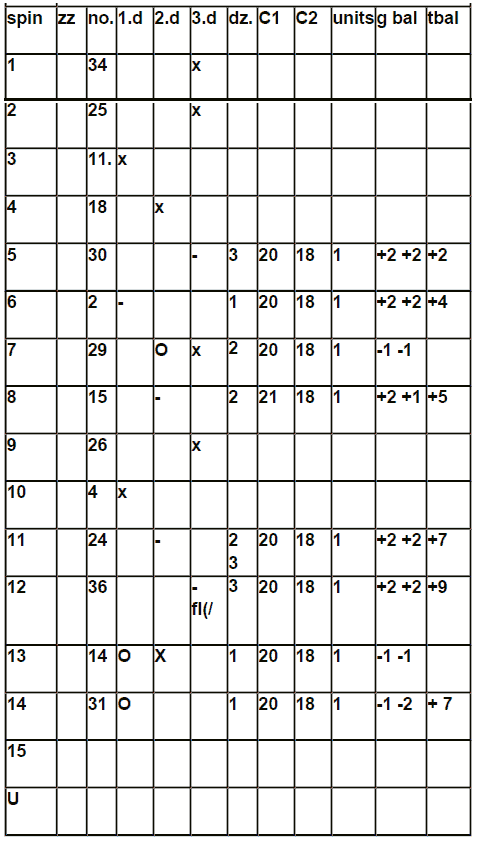
The record sheet for the Challenge 2.1 roulette strategy is designed to fit on paper the size of a letter. If you prefer you can print it on paper of legal size. The sheet contains a header line with a box for the session date, 64 spin lines, and 13 columns to enter all necessary numbers.
In the record sheet below we have omitted the header, and the box for the session date, Instead in the header tine the columns are numbered for a better understanding.
|
1 |
2 |
3 |
4 |
5 |
6 |
7 |
8 |
9 |
10 |
11 |
12 |
Comments |
|
Spin |
ZZ |
No. |
1d |
2d |
3d |
Dz. |
C1 |
C2 |
Units |
GBal |
TBal |
|
|
1 |
|
|
|
|
|
|
|
|
|
|
|
|
|
2 |
|
|
|
|
|
|
|
|
|
|
|
|
|
3 |
|
|
|
|
|
|
|
|
|
|
|
|
|
4 |
|
|
|
|
|
|
|
|
|
|
|
|
|
5 |
|
|
|
|
|
|
|
|
|
|
|
|
|
6 |
|
|
|
|
|
|
|
|
|
|
|
|
|
7 |
|
|
|
|
|
|
|
|
|
|
|
|
|
8 |
|
|
|
|
|
|
|
|
|
|
|
|
|
9 |
|
|
|
|
|
|
|
|
|
|
|
|
|
***** |
|
|
|
|
|
|
|
|
|
|
|
|
|
62 |
|
|
|
|
|
|
|
|
|
|
|
|
|
63 |
|
|
|
|
|
|
|
|
|
|
|
|
|
64 |
|
|
|
|
|
|
|
|
|
|
|
|
Columns:
- Spin number
- - enter Zero or Double Zero here
- - enter the come out number here
- 1d - mark a first dozen numbers here with an X
- 2d - mark a second dozen numbers here with an X
- 3d - mark a third dozen numbers here with an X
- - enter her the dozen you want to bet on this spin
- C1 - progression Code 1 is entered here
- C2 - progression Code 2 is entered here
- Units - the number of units you want to bet on this spin
- GBal - the result of that bet is entered here
- TBal - the game balance is entered here
- Comments - here the session balance is entered after completion of a game
Example:
Basic Betting Pattern
Challenge 2.1 adapts to the spin run and designates a bet on a dozen or a column whenever a hit for this change is most probable. Following all demonstrations are executed on dozens, they apply equally also to columns. The attack signal for Challenge 2.1 Is the appearance of all three dozens in three consecutive spins
This is our basic pattern to determine where to place our bets.
There are six possible appearances of this pattern:
|
Spin |
ZZ |
No. |
1d |
2d |
3d |
|
1 |
|
10 |
X |
|
|
|
2 |
|
17 |
|
X |
|
|
3 |
|
26 |
|
|
X |
|
4 |
|
|
|
|
|
|
Spin |
ZZ |
No. |
1d |
2d |
3d |
|
1 |
|
12 |
X |
|
|
|
2 |
|
25 |
|
|
X |
|
3 |
|
14 |
|
X |
|
|
4 |
|
|
|
|
|
|
Spin |
ZZ |
No. |
1d |
2d |
3d |
|
1 |
|
16 |
|
X |
|
|
2 |
|
11 |
X |
|
|
|
3 |
|
32 |
|
|
X |
|
4 |
|
|
|
|
|
|
Spin |
ZZ |
No. |
1d |
2d |
3d |
|
1 |
|
15 |
|
X |
|
|
2 |
|
27 |
|
|
X |
|
3 |
|
9 |
X |
|
|
|
4 |
|
|
|
|
|
|
Spin |
ZZ |
No. |
1d |
2d |
3d |
|
1 |
|
33 |
|
|
X |
|
2 |
|
13 |
|
X |
|
|
3 |
|
8 |
X |
|
|
|
4 |
|
|
|
|
|
|
Spin |
ZZ |
No. |
1d |
2d |
3d |
|
1 |
|
36 |
|
|
X |
|
2 |
|
7 |
X |
|
|
|
3 |
|
18 |
|
X |
|
|
4 |
|
|
|
|
|
We bet always on the dozen that did appear first in this sequence.
Example No. 1: 1999-08-01
|
1 |
2 |
3 |
4 |
5 |
6 |
7 |
8 |
9 |
10 |
11 |
12 |
Comments |
|
Spin |
ZZ |
No. |
1d |
2d |
3d |
Dz. |
C1 |
C2 |
Units |
GBal |
TBal |
|
|
1 |
|
17 |
|
X |
|
|
|
|
|
|
|
|
|
2 |
|
10 |
X |
|
|
|
|
|
|
|
|
|
|
3 |
|
2 |
X |
|
|
|
|
|
|
|
|
|
|
4 |
|
20 |
|
X |
|
|
|
|
|
|
|
|
|
5 |
|
6 |
X |
|
|
|
|
|
|
|
|
|
|
6 |
|
29 |
|
|
X |
|
|
|
|
|
|
|
|
7 |
|
22 |
|
|
X |
2 |
20 |
IS |
1 |
+2 |
|
|
With spins 4 (20, second dozen), 5 ( 6, first dozen), and 6 (29, third dozen) we see all three dozens in three consecutive spins. For the next spin, we place our bet on the second dozen. Spin 7: No. 20 comes out, we win our bet.
Example No. 2: 1999-08-03
|
1 |
2 |
3 |
4 |
5 |
6 |
7 |
8 |
9 |
10 |
11 |
12 |
Comments |
|
Spin |
ZZ |
No. |
1d |
2d |
3d |
Dz. |
C1 |
C2 |
Units |
GBal |
TBal |
|
|
1 |
|
16 |
|
X |
|
|
|
|
|
|
|
|
|
2 |
|
34 |
|
|
X |
|
|
|
|
|
|
|
|
3 |
|
16 |
|
X |
|
|
|
|
|
|
|
|
|
4 |
|
16 |
|
X |
|
|
|
|
|
|
|
|
|
5 |
|
36 |
|
|
X |
|
|
|
|
|
|
|
|
6 |
|
36 |
|
|
X |
|
|
|
|
|
|
|
|
7 |
|
17 |
|
X |
|
|
|
|
|
|
|
|
|
8 |
|
21 |
|
X |
|
|
|
|
|
|
|
|
|
9 |
|
35 |
|
|
X |
|
|
|
|
|
|
|
|
10 |
|
4 |
X |
|
|
|
|
|
|
|
|
|
|
11 |
|
16 |
|
X |
|
2 |
20 |
18 |
1 |
+2 |
+2 |
|
Spins 8 (21, second dozen), 9 ( 35, third dozen), and 10 (4, first dozen). Again we nave all three dozens in three consecutive spins. For spin 11 we place our bet on the second dozen. Spin 11: No. 16 comes out, we win our bet.
Example No. 3: 1999-08-07
|
1 |
2 |
3 |
4 |
5 |
6 |
7 |
8 |
9 |
10 |
11 |
12 |
Comments |
|
Spin |
ZZ |
No. |
1d |
2d |
3d |
Dz. |
C1 |
C2 |
Units |
GBal |
TBal |
|
|
1 |
|
31 |
|
|
X |
|
|
|
|
|
|
|
|
2 |
|
25 |
|
|
X |
|
|
|
|
|
|
|
|
3 |
|
11 |
X |
|
|
|
|
|
|
|
|
|
|
4 |
|
18 |
|
X |
|
|
|
|
|
|
|
|
|
5 |
|
30 |
|
|
X |
3 |
20 |
18 |
1 |
+2 |
+2 |
+2 |
Spins 2, 3, and 4 bring up our basic pattern so for the next spin we place our bet on the third dozen. Spin 5: No. 30 comes out. We win our bet.
Example No. 4: 1999-08-10
|
1 |
2 |
3 |
4 |
5 |
6 |
7 |
8 |
9 |
10 |
11 |
12 |
Comments |
|
Spin |
ZZ |
No. |
1d |
2d |
3d |
Dz. |
C1 |
C2 |
Units |
GBal |
TBal |
|
|
1 |
|
34 |
|
|
X |
|
|
|
|
|
|
|
|
2 |
|
36 |
|
|
X |
|
|
|
|
|
|
|
|
3 |
|
7 |
X |
|
|
|
|
|
|
|
|
|
|
4 |
|
6 |
X |
|
|
|
|
|
|
|
|
|
|
5 |
|
8 |
X |
|
|
|
|
|
|
|
|
|
|
6 |
|
33 |
|
|
X |
|
|
|
|
|
|
|
|
7 |
|
22 |
|
X |
|
|
|
|
|
|
|
|
|
8 |
|
4 |
X |
|
|
|
1 |
20 |
18 |
1 |
+2 |
+2 |
The spins 5, 6, and 7 produce again our basic pattern (No. 8 33, and 22, all three dozens in three consecutive spins). We bet the first dozen on the next spin. No. 4 comes out: we win our bet.
In the examples above we have always had a hit on our first bet. That. naturally will not happen every time. if our first bet fails to hit. We bet again the same dozen on the next spin:
Example No. 5: 1999-08-12
|
1 |
2 |
3 |
4 |
5 |
6 |
7 |
8 |
9 |
10 |
11 |
12 |
Comments |
|
Spin |
ZZ |
No. |
1d |
2d |
3d |
Dz. |
C1 |
C2 |
Units |
GBal |
TBal |
|
|
1 |
|
14 |
|
X |
|
|
|
|
|
|
|
|
|
2 |
|
10 |
X |
|
|
|
|
|
|
|
|
|
|
3 |
|
10 |
X |
|
|
|
|
|
|
|
|
|
|
4 |
|
14 |
|
X |
|
|
|
|
|
|
|
|
|
5 |
|
20 |
|
X |
|
|
|
|
|
|
|
|
|
6 |
|
34 |
|
|
X |
|
|
|
|
|
|
|
|
7 |
|
20 |
|
X |
|
|
|
|
|
|
|
|
|
8 |
|
16 |
|
X |
|
|
|
|
|
|
|
|
|
9 |
|
4 |
X |
|
|
|
|
|
|
|
|
|
|
10 |
|
13 |
|
X |
|
|
|
|
|
|
|
|
|
11 |
|
30 |
|
|
X |
|
|
|
|
|
|
|
|
12 |
|
22 |
|
X |
|
1 |
20 |
18 |
1 |
-1 |
|
|
|
13 |
|
3 |
X |
|
|
1 |
21 |
18 |
1 |
+2 |
+1 |
|
With spins 9, 10, and 11( No's 4,13, and 30) we find our pattern. We have now to place a bet on the first dozen. Spin 12 comes up with No. 22. We lose our bet. On the next spin, we bet again on the first dozen Spin 13 comes up with No. 3. We win our bet.
Example No. 6: 1999-08-20
|
1 |
2 |
3 |
4 |
5 |
6 |
7 |
8 |
9 |
10 |
11 |
12 |
Comments |
|
Spin |
ZZ |
No. |
1d |
2d |
3d |
Dz. |
C1 |
C2 |
Units |
GBal |
TBal |
|
|
1 |
0 |
3 |
X |
|
|
|
|
|
|
|
|
|
|
2 |
|
31 |
|
|
X |
|
|
|
|
|
|
|
|
3 |
|
11 |
X |
|
|
|
|
|
|
|
|
|
|
4 |
|
20 |
|
X |
|
|
|
|
|
|
|
|
|
5 |
|
2 |
X |
|
|
3 |
20 |
18 |
1 |
-1 |
-1 |
|
|
6 |
|
6 |
X |
|
|
3 |
21 |
18 |
1 |
-1 |
-2 |
|
|
7 |
|
32 |
|
|
X |
3 |
22 |
18 |
1 |
+2 |
0 |
|
Again with No.'s 31, 11, and 20 (spins 2, 3, and 4) we see our basic pattern. We place our bet for spin five on the third dozen. No. 2 comes out on spin 5. We lose our bet. On spin 6 we bet again the third dozen. No. 6 comes out. We lose this bet also. We place a bet on the third dozen the third time. On spin 7 No. 32 comes out, we win this bet.
If a third bet In the betting sequence is lost we stop the game. Now we have to wait for our basic pattern downstream of the.
Try This Strategy in TOP Live Casinos





Example No. 7: 1999-08-23
|
1 |
2 |
3 |
4 |
5 |
6 |
7 |
8 |
9 |
10 |
11 |
12 |
Comments |
|
Spin |
ZZ |
No. |
1d |
2d |
3d |
Dz. |
C1 |
C2 |
Units |
GBal |
TBal |
|
|
1 |
|
7 |
X |
|
|
|
|
|
|
|
|
|
|
2 |
|
31 |
|
|
X |
|
|
|
|
|
|
|
|
3 |
|
33 |
|
|
X |
|
|
|
|
|
|
|
|
4 |
|
13 |
|
X |
|
|
|
|
|
|
|
|
|
5 |
|
31 |
|
|
X |
|
|
|
|
|
|
|
|
6 |
|
23 |
|
X |
|
|
|
|
|
|
|
|
|
7 |
|
6 |
X |
|
|
|
|
|
|
|
|
|
|
8 |
|
24 |
|
X |
|
3 |
20 |
18 |
1 |
-1 |
-1 |
|
|
9 |
|
6 |
X |
|
|
3 |
21 |
18 |
1 |
-1 |
-2 |
|
|
10 |
|
20 |
|
X |
|
3 |
22 |
18 |
1 |
-1 |
-3 |
|
|
11 |
|
8 |
X |
|
|
|
|
|
|
|
|
|
|
12 |
|
4 |
X |
|
|
|
|
|
|
|
|
|
|
13 |
|
21 |
|
X |
|
|
|
|
|
|
|
|
|
14 |
|
14 |
|
X |
|
|
|
|
|
|
|
|
|
15 |
|
22 |
|
X |
|
|
|
|
|
|
|
|
|
16 |
|
11 |
X |
|
|
|
|
|
|
|
|
|
|
17 |
|
1 |
X |
|
|
|
|
|
|
|
|
|
|
18 |
|
16 |
|
X |
|
|
|
|
|
|
|
|
|
19 |
|
30 |
|
|
X |
|
|
|
|
|
|
|
|
20 |
|
10 |
X |
|
|
1 |
23 |
18 |
1 |
+2 |
-1 |
|
|
21 |
|
13 |
|
X |
|
2 |
21 |
16 |
1 |
+2 |
+1 |
+1 |
|
22 |
|
35 |
|
|
X |
3 |
20 |
18 |
1 |
+2 |
+2 |
+3 |
|
23 |
|
4 |
X |
|
|
1 |
20 |
18 |
1 |
+2 |
+2 |
+5 |
In spins 5, 6, and 7 we see our basic pattern. Now we have to bet the third dozen. On spin 8 No. 24 comes out we lose this bet Again we bet on the third dozen. Spin 9 is lost also because No. 6 comes out. We bet a third time on the third dozen and lose again due to No. 20 on spin 10. We stop and continue to record the spins. Spins 17,18, and 19 produce our basic pattern (No's 1,16, and 30).
For spin 20 we have to place a bet on the first dozen. Spin 20: No. 10, we win this bet. We use this new pattern in spins 18, 19, and 20 (No's 16, 30, and 10) to determine a new bet: we have to bet on the second dozen on spin 21. Spin 21: No. 13, we win this bet too.
Now we use the pattern of spins 19, 20, and 21 (No's 30,10, and 13) to determine a new bet on the third dozen on spins 22 - 22: No. 35, we win this bet spin 20, 21, and 22 forms again our basic pattern.
We have to bet on the first dozen on spin 23. Spin 23: No. 4, we win this bet.
After the appearance of our basic pattern, we begin betting whenever a first bet hits. A new basic pattern with the two previous spins is produced. We will use this pattern to determine a new bet, and place that bet on the very next spin!
Important: If a second or a third bet in a betting sequence hits. we have to wait for a new basic pattern downstream of the hit-The spin of the last won bet may be part of this new pattern.
Example 09-29-1999: spins 21. 22, and 23 form the new pattern 'They are downstream from the last lost bet. We cannot use spins 19, 20, and 21 or spins 20, 21, and 22!
|
17 |
|
16 |
|
X |
|
|
|
18 |
|
8 |
X |
|
|
|
|
19 |
|
31 |
|
|
X |
|
|
20 |
|
3 |
X |
|
|
2 |
|
21 |
|
19 |
|
X |
|
2 |
|
22 |
|
30 |
|
|
X |
|
|
23 |
|
8 |
X |
|
|
|
|
24 |
|
24 |
|
X |
|
|
Example 10-04-1999: spins 11, 12, and 13 forms the new pattern. They are downstream from the last lost bet. We cannot use spins 9, 10, and 11!
|
6 |
|
5 |
X |
|
|
|
|
7 |
|
16 |
|
X |
|
|
|
8 |
|
36 |
|
|
X |
|
|
9 |
|
21 |
|
X |
|
1 |
|
10 |
|
34 |
|
|
X |
1 |
|
11 |
|
11 |
X |
|
|
1 |
|
12 |
|
29 |
|
|
X |
|
|
13 |
|
14 |
|
X |
|
|
|
14 |
|
9 |
X |
|
|
1 |
After three lost bets, we stop betting, and wait for a new basic pattern downstream of the last lost bet, before we continue with our game!
Example 1999-08-10: spins 37, 38, and 39 form our basic pattern. However, we can not use these spins because only spins 39 are downstream from the last lost bet!
|
32 |
|
34 |
|
|
X |
|
|
33 |
|
4 |
X |
|
|
|
|
34 |
|
16 |
|
X |
|
|
|
35 |
|
35 |
|
|
X |
3 |
|
36 |
|
36 |
|
|
X |
1 |
|
37 |
|
14 |
|
X |
|
1 |
|
38 |
|
32 |
|
|
X |
1 |
|
39 |
|
3 |
X |
|
|
|
|
40 |
|
24 |
|
X |
|
|
|
41 |
|
26 |
|
|
X |
|
|
42 |
|
34 |
|
|
X |
1 |
|
43 |
|
14 |
|
X |
|
1 |
|
44 |
|
5 |
X |
|
|
1 |
It s as simple as that.
In the next section, we will introduce you to our progression, Challenge 2.1
The Progression
Systems that use equal size bets generally contain long-lasting stagnation phases, which make a strategic play uneconomic. expenditure of time and yield are in no profitable relation to each other. As alternative many systems offer a variety of progressions. However, all progressions have the disadvantage that with increasing bet sizes the Zero-tax gradually grows also, until the progression can't regain the amount lost to Zero or Doublezero 1.
Based on this realization Cosmo-Research has constructed a progression. from now on called DIVISION, which goes a new, intelligent way.
The starting point of DIVISION is that with a large probability within a limited spin sequence there will be a certain number of hits.
When these hits will come is unpredictable, but that the hits will come is probabilistically provable, DIVISION uses 2 Code numbers, put into relation to each other.
From their variable relation, the bet size is determined. This type of bet size determination can be used profitably on even money, and twelve number bets.
Now we are going to demonstrate how DIVISION works on even money bets assuming that the system X will hit five times within a specific sequence of consecutive roulette spins.
Gain target is 5 units:
|
Bet No. |
Win (W) /Loss (L) |
Code 1 |
Code 2 |
Division |
Result |
Bet |
Balance |
|
1 |
L |
5 |
5 |
5/5 |
1 |
-1 |
-1 |
|
2 |
L |
6 |
5 |
6/5 |
1 |
-1 |
-2 |
|
3 |
L |
7 |
5 |
7/5 |
1 |
-1 |
-3 |
|
4 |
W |
8 |
5 |
8/5 |
2 |
+2 |
-1 |
|
5 |
W |
6 |
4 |
6/4 |
2 |
+2 |
+1 |
|
6 |
L |
4 |
3 |
4/3 |
1 |
-1 |
0 |
|
7 |
W |
5 |
3 |
5/3 |
2 |
+2 |
+2 |
|
8 |
L |
3 |
2 |
2/3 |
2 |
-2 |
0 |
|
9 |
W |
5 |
2 |
6/2 |
3 |
+3 |
+3 |
|
10 |
W |
2 |
1 |
2/1 |
2 |
+2 |
+5 |
Although plus, and minus are even, we have 5 hits, and 5 failed hits. D
DIVISION results with a 5 unit gain. How is this gain achieved?
The Code numbers of 5 were set against each other. Code 1 can be a set variable, it orients itself at the increase of bet sizes, up to which you are willing to go The higher the Code 1, the more steeply the bet size is increasing.
Code 2 corresponds to the number of hits. which you expect. The two Code numbers are divided by each other. Results smaller man I am rounded up to 1 unit. Results of the division greater than 1 - 4 are rounded up to 2 units, results between 2, and 2 4 are rounded down to 2, from 2-5 rounded up to 3, and so forth.
Code 1 is increased after a loss by the number of the lost units. It is reduced after a hit by deduction of the amount of won units.
Code 2 remains unchanged after a loss and is reduced after a hit by 1 pay-out ratio of even money bets).
A further demonstration of DIVISION with the expectation of a 10 unit gain after 10 hits follows:
|
Bet No. |
Win (W) /Loss (L) |
Code 1 |
Code 2 |
Division |
Result |
Bet |
Balance |
|
1 |
L |
10 |
10 |
10/10 |
1 |
-1 |
-1 |
|
2 |
L |
11 |
10 |
11/10 |
1 |
-1 |
-2 |
|
3 |
L |
12 |
10 |
12/10 |
1 |
-1 |
-3 |
|
4 |
W |
13 |
10 |
13/10 |
1 |
+1 |
-2 |
|
5 |
W |
12 |
9 |
12/9 |
1 |
+1 |
-1 |
|
6 |
L |
11 |
8 |
11/8 |
1 |
-1 |
-2 |
|
7 |
L |
12 |
8 |
12/8 |
2 |
-2 |
-4 |
|
8 |
W |
14 |
8 |
14/8 |
2 |
+2 |
-2 |
|
9 |
W |
12 |
7 |
12/7 |
2 |
+2 |
0 |
|
10 |
W |
10 |
6 |
10/6 |
2 |
+2 |
+2 |
|
11 |
L |
8 |
5 |
8/5 |
2 |
-2 |
0 |
|
12 |
W |
10 |
5 |
10/5 |
2 |
+2 |
+2 |
|
13 |
L |
8 |
4 |
8/4 |
2 |
-2 |
0 |
|
14 |
W |
10 |
4 |
10/4 |
3 |
+3 |
+3 |
|
15 |
L |
7 |
3 |
7/3 |
2 |
-2 |
+1 |
|
16 |
L |
9 |
3 |
9/3 |
3 |
-3 |
-2 |
|
17 |
W |
12 |
3 |
12/3 |
4 |
+4 |
+2 |
|
18 |
L |
8 |
2 |
8/2 |
4 |
-4 |
-2 |
|
19 |
W |
12 |
2 |
12/2 |
6 |
+6 |
+4 |
|
20 |
W |
6 |
1 |
6/1 |
6 |
+6 |
+10 |
This demonstration proves the basic operability of DIVISION: with 10 hits, and 10 lost bets after 20 placed bets we see again a 10 unit gain To keep bet sizes within a defensive limit we recommend two reductions:
- An attack should be aborted if a positive balance is achieved. During the 2 demonstrations that would be after the 10 placed bet. In the Chat case, the attack ends with a 2 unit gain. A new attack can be started immediately, which begins again with Code 1 as 10, and Code 2 as 10.
- An attack should be aborted likewise when Code 2 falls below 3 even when the total balance is stilt negative. Both measures will keep the table bankroll at a reasonable limit and will reduce the imponderability of the Zero-tax substantially.
To fully use the elasticity of a specific roulette strategy Code, 2 should not amount to under 10. A higher base value is quite possible, however not over 20, since then an attack can drag on for a long time.
Code 1 can be defined variable, it should for the start amount to half the value of Code 2. Thus with Code 2 being 20, Code 1 would be at least 10, which would be a very restrictive play with low starting bet sizes. Particularly important if the probability of hits is rather small, offensive betting is possible, if the probability of a future hit accumulation exists, for example after a lost session. In this case, Code 1 can be fixed on 28, Code 2 on 20.
An ideal relation for the beginning is identical Code numbers, for example, 20/20.
With each starting relation of Code numbers, an extremely variable play with as outstanding gain perspectives as possible!
After introducing you to DIVISION for even money bets, we will now demonstrate the use of DIVISION with twelve number bets. Due to the pay-out ratio of 2:1 on twelve number bets, DIVISION is ideally suited for this kind of system!
We start with Code 1 as 20, and Code 2 as 18, 18 corresponds to an adequate score you can expect 9 hits with a 2 unit gain = total gain of 18 units!
Once again we demonstrate the determination of bet sizes: The two Code numbers are divided against each other (20:18). Results less than 1 will be rounded up to 1. Results of the division starting from 1.5 are rounded up to 2 units, results between 2, and 2.4 are rounded down to 2, from 2.5 rounded up to 3, and so forth.
Code 1 is increased after a loss by the number of the lost units, it is reduced after a hit by deduction of the amount of won units.
Code 2 remains unchanged after a toss and Is reduced after* hit by 2 (payout ratio of twelve number bets).
|
Bet No. |
Win (W) /Loss (L) |
Code 1 |
Code 2 |
Division |
Result |
Bet |
Balance |
|
1 |
L |
20 |
18 |
20/18 |
1 |
-1 |
-1 |
|
2 |
L |
21 |
18 |
21/18 |
1 |
-1 |
-2 |
|
3 |
L |
22 |
18 |
22/28 |
1 |
-1 |
-3 |
|
4 |
W |
23 |
18 |
23/18 |
1 |
+2 |
-1 |
|
5 |
L |
21 |
16 |
21/16 |
1 |
-1 |
-2 |
|
6 |
L |
22 |
16 |
22/16 |
1 |
-1 |
-3 |
|
7 |
L |
23 |
16 |
23/16 |
1 |
-1 |
-4 |
|
8 |
W |
24 |
16 |
24/16 |
2 |
+4 |
0 |
|
9 |
L |
20 |
14 |
20/14 |
1 |
-1 |
-1 |
|
10 |
L |
21 |
14 |
21/14 |
2 |
-2 |
-3 |
|
11 |
L |
23 |
14 |
23/14 |
2 |
-2 |
-5 |
|
12 |
W |
25 |
14 |
25/14 |
2 |
+4 |
-1 |
|
13 |
W |
21 |
12 |
21/12 |
2 |
+4 |
+3 |
After 13 placed bets (with 18 units wagered ), and only 4 hits, DIVISION achieves a 3 unit gain! The attack is terminated.
New attack with Codes 20:18.
In the next section, we will demonstrate the integration of the basic betting pattern with DIVISION.
In the example below we show, how the basic pattern is combined with the progression division. After three lost bets in sequence, we stop the attack until the basic pattern appears again. An attack is terminated whenever an effective positive result Is achieved (this is marked with the letter S).
Immediately we start a new attack with the code numbers 20 against 18.
|
1 |
2 |
3 |
4 |
5 |
6 |
7 |
8 |
9 |
10 |
11 |
12 |
Comments |
|
Spin |
ZZ |
No. |
1d |
2d |
3d |
Dz. |
C1 |
C2 |
Units |
GBal |
TBal |
|
|
1 |
|
17 |
|
X |
|
|
|
|
|
|
|
|
|
2 |
|
10 |
X |
|
|
|
|
|
|
|
|
|
|
3 |
|
26 |
|
|
X |
|
|
|
|
|
|
|
|
4 |
|
20 |
|
X |
|
|
|
|
|
|
|
|
|
5 |
|
6 |
X |
|
|
|
|
|
|
|
|
|
|
6 |
|
29 |
|
|
X |
|
|
|
|
|
|
|
|
7 |
|
22 |
|
X |
|
2 |
20 |
18 |
1 |
+2 |
+2 |
+2S |
|
8 |
|
8 |
X |
|
|
1 |
20 |
18 |
1 |
+2 |
+2 |
+4S |
|
9 |
|
22 |
|
X |
|
3 |
20 |
18 |
1 |
-1 |
-1 |
|
|
10 |
|
22 |
|
X |
|
3 |
21 |
18 |
1 |
-1 |
-2 |
|
|
11 |
|
3 |
X |
|
|
3 |
21 |
18 |
1 |
-1 |
-3 |
|
In section DEMONSTRATION you will find two sessions with spin-by-spin explanations.
Win/Loss Limits
For successful systematical betting with the roulette strategy Challenge 2.1, you must keep strictly to all listed limits! The 31 sessions played in August 1999 cover all limits. Every record sheet of these sessions contains an explanation of the limits used.
- Game attack gain target: minimum 1 unit, IF the first bet of a game, is a hit you win 2 units (see session 1999-08-01) Sometimes when a game begins with a couple of losses, and the progression gets active a game may even end with a 3 or 4 unit gain (see session 1999-08-06, and 1999-08-08)
- Game length time 45 Ideal spins. (Ideal spins do not count the spins for Zero or Double Zero)
- Game Loss Limit Minus 13 Units (see Session 1999-10-21)
- Session Gain Target 5 Units in 45 ideal spins recommended 3 games/attacks
- Session Stop Limits if after 45 Ideal spins a session, and a previous positive session balance your last game is still negative this last game, and the session as well is terminated.
- once the balance of your last game reaches a positive value (see session 1999-08-02)
- The game limit of 45 Spins is reached (see Session 1999-08-05) maximum session length 64 spins
Stop/Loss Procedure
Approximately 50 % of the time you will reach the session goal of a 5 unit gain in less than 45 spins. To maximize the profit, we recommend the following procedure: of your 5 unit gain, you can use 2 units for further attacks. If the 2 units are lost, you stop this new attack and keep the 3 units. After a gain of 6,7, 8, or 9 units you do the same: after the loss of 2 units, you terminate the attack.
After a gain of 10 units, you terminate the attack after a loss of 3 units with plus 7. After a gain of 11, 12, 13 Other 14 units you lose max. 4 units-Then the attack is terminated.
If your total gain is more than 14 units, your maximum loss is restricted to 5 units.
With this Stop-Loss Procedure, you can ride winning streaks, and avoid losing streaks,
The table below shows the limits again:
|
Gain |
Stop |
|
+5 |
+3 |
|
+6 |
+4 |
|
-7 |
+5 |
|
+8 |
+6 |
|
+9 |
+7 |
|
+10 |
+7 |
|
+11 |
+7 |
|
+12 |
+8 |
|
+13 |
+9 |
|
+14 |
+10 |
|
+15 |
+10 |
This Stop/Loss Procedure was used during the 31 sessions played in August 1999. Every record sheet contains an explanation of the used stop limit.
Dont forget: This strategy collected from internet. LiveCasinoGuru is not responsible for the accuracy of this information. It is presented for information purposes only. Our task is to collect and present strategies to share experiences. Any possible wins and losses are the responsibility of the player.