4. Variations of This System
There can be many variations and as always the possible profits are in direct relationship to the risk that one wants to take.
With the same risk, same yield, and the same percentages of success there are the following options:
- Attempt the recovery in three bets on the groups of 3 consecutive series of 1 and higher. Every group should appear every 30 plays. The deficit rises more slowly as we are dividing it into 3 and the groups of 2 allow us to reduce it in a third party.
- In a group of 4 consecutive series of 1. There are three groups in total and the appearance interval is of one every 82 plays. The groups of 2 reduce the fourth part the deficit to recover, and those of 3 reduce it to half.
- In those of 5 we would be waiting for a phenomenon that has a possibility of occurring every 247 plays, and though the deficit rises very slowly and the inferior groups (2, 3, and 4) produce a certain relief, we consider that we would be playing too much time under the pressure of recovery. And we have seen in the case of the group of 2 that the appearance of the phenomenon (though it is an extraordinary situation), can multiply by five the average interval of appearance.
With a greater risk of capital there can be many options:
- Bet on the break of the series of 1. When attempting the recoveries we have to add a unit every time, and the yield increases in a way proportional to the risk of not being able to assume the recovery deficit. In this case, the yield can oscillate between 0.30 and 0.40 chips per play.
- Lengthen the bet on the series higher than 4.
- Intensify the bets in the first series (e.g.: 3 units in the series of 1, 2 units in the series of 2, and 1 unit in the remaining series).
The reader will probably need the graphic representation of the possibilities of the system, but we will not make it, and we will now explain the cause:
We are very satisfied with the results, obtained from a method which is of difficult practical application, but yet, these results can be improved.
Can we play in a way yet more intelligent? Of course, we can do it and we can manage to minimize the scarce possibilities that chance has of leaving victorious, but, furthermore, we will have an almost total tranquillity during the game. Our method will come closest to what it could be called the "infallible" method, and the possibilities of success will be 98%.
We will now explain this:
The previous method puts all the losses produced by the series of 2, 3, and 4 in the same bank and attempts to recover them in 2 bets on 2 consecutive series of 1. We have a total of 17 groups of series of 1 that have to recover the deficit caused by the sum of all the series of 2 or higher, which makes in total 31. If we add to this figure all the series of 2 and higher that prevent us from recovering (63), this means that we are fighting at a clear disadvantage against the BANK. In short sequences with only the appearance of series higher than 1, we can find that the deficit increases very quickly and exceeds our initial limit. And just after exceeding ourselves, groups of series of 1 appear that are no longer used to us. We have to establish a more egalitarian relationship with the BANK. We achieve this by dividing this deficit into three independent banks (everyone will make his recovery). We explain the procedure below:
We will bet a unit on the break of the series of 2, 3, and 4. The obtained units are direct profits.
1. The units lost when appearing a series of 3 will be put in a bank of losses number 1, and they will be divided into 3. For the chips of columns 1 and 2, we will attempt to recover them in 2 consecutive bets with the appearance of a group of 2 consecutive series of 1 or higher.
GRAPHIC 21
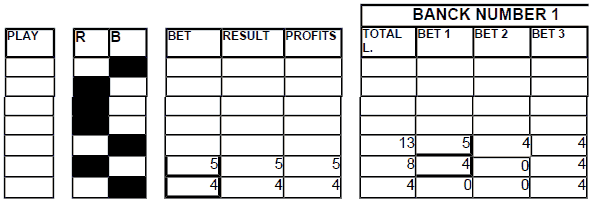
When they appear 2 series of 1 consecutive, in the following play is not bet the figure of the column number 3. The figure of column number 3 will be bet only in the third play to the break of the series of 2 (32 series).
When it is lost one of the recovery bets (1, 2, or 3) is added to the deficit and this is returned to divide between 3.
GRAPHIC 22
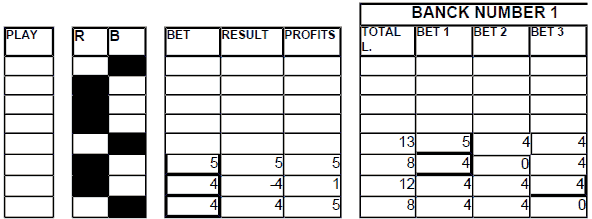
Possible causes:
GRAPHIC 23
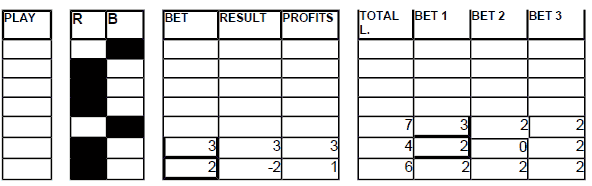
GRAPHIC 24
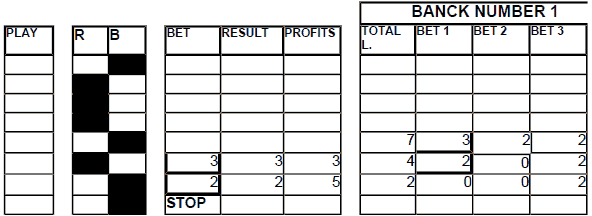
GRAPHIC 25
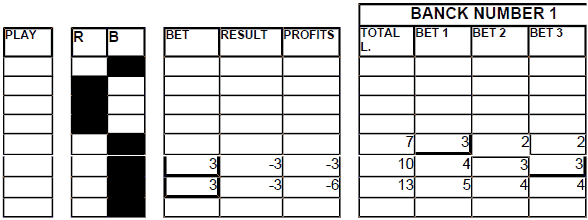
GRAPHIC 26
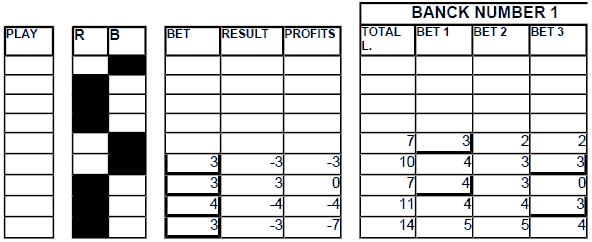
GRAPHIC 27
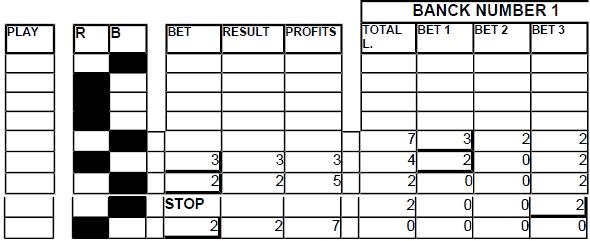
GRAPHIC 28
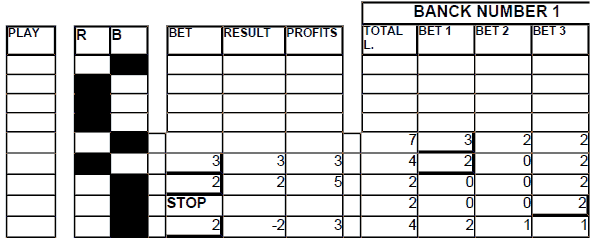
2. The units lost when appearing a series of 4 will be put in a bank of losses number 2, they will be divided into 2, and we will attempt to recover them in 2 consecutive bets with the appearance of a series of 3: when a series of 2 appears, we will play on the appearance of a series of 3 and we will make the first bet on the continuation of the series and the following on the break.
GRAPHIC 29
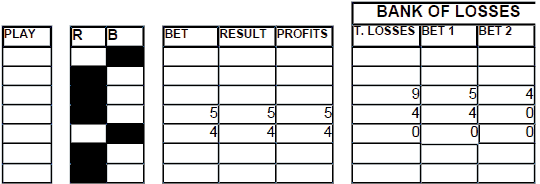
3. The units lost when appearing a series of 5 will be put in a bank of losses number 3, they will be divided into 2, and we will attempt to recover them in 2 consecutive bets with the appearance of a series of 4: when a series of 3 appears, we will play on the appearance of a series of 4 and we will make the first bet on the continuation of the series and the following on the break.
GRAPHIC 30
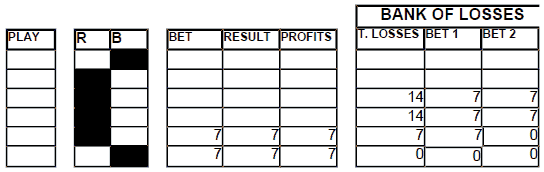
Every bank of losses is independent of the other and has as objective to close its recovery. We recover the losses produced by a series with the appearance of an immediately inferior one in the cases of the series of 4 and 5, and in the case of those of 3 we continue to make it with the groups of 2 consecutive series of 1 and 32 series of 2
- RECOVERY WITH THE GROUPS OF SERIES OF 1 AND SERIES OF 2 (BANK OF LOSSES NUMBER 1). With 49 valid groups, we attempt to recover the losses produced by sixteen series of 3, two of 6, one of 7, and the ones produced by the 31 series higher to 2 when failing the first recovery bet (increases in 1/2 the deficit).
- RECOVERY WITH THE SERIES OF 3 (BANK NUMBER 2). With 16 groups we attempt to recover the losses produced by eight series of 4, two of 6, one of 7, and the ones produced by the thirty-two series of 2 when failing the first recovery bet (increases in 1/2 the deficit).
- RECOVERY WITH THE SERIES OF 4 (BANK NUMBER 3). With 8 valid groups, we attempt to recover the losses produced by four series of 5, two of 6, one of 7, and the ones produced by the sixteen series of 3 when failing the first recovery bet (increases in 1/2 the deficit).
We have improved a lot but it is not still enough since we have a recovery bank (number 1) which gives too many facilities to the BANK and in a critical situation it would take us beyond our initial limit. We know also, thanks to the analysis of thousands of plays that, when a given phenomenon does not want to appear, little can traditional methods do. We will put an example: we can have 0 in the bank's number 1 and 3 and an average deficit in the number 2. So we would only need a series of 3 to cancel it (a series of 3 should appear regularly once every 15 plays, but we have already seen that this theoretical interval can be multiplied by 5 in practice). In these moments, during 50 plays, we see the appearance of a sequence (that it may be only once in 1000 plays, but when it happens makes our method useless), with many series of 1 and 2 chained with series of 4 and higher that make the deficit of bank number 2 quickly exceed our limit. Our predictions based on the calculation of probabilities will be of no use.
How to solve the problem? The solution is given to us by chance itself: when a given phenomenon does not appear, it means that others are appearing. When a series of 3 does not appear, others must appear (1, 2, 4, 5, etc.). This is the key to the problem, to avoid the absence of a given phenomenon should be solved with this same phenomenon. If we can make the absence of a given phenomenon be solved, at least in part, by 2 different ones, we will avoid in 98% of occasions the collapse of the system. We do not like using the term 100%, since we know that a situation that has not appeared in 10000 plays can present itself in the least unexpected moment, but, when we finish explaining the system, all the readers will have to agree with us that this is the method that comes closest to the term "infallible" if it can not be called this way.
What is certain is that you will be prepared to endure critical situations that no other method could resist, finally recovering all the losses and obtaining a yield more than acceptable. To all this, we have to add the fact that the investment of capital that we need to put into practice is really low.
How can we make the absence of a phenomenon be solved by the appearance of others opposed? When a recovery bet fails and it is equal to or higher than 3 units, instead of adding it completely to our bank, it will be distributed into 3 banks.
Ex: We have in bank number 2 a deficit of 9 units ( there appear series of 2, of 4 and higher and none of 3). The first recovery of 5 fails. Instead of adding it totally to bank number 2 which would make a total of - 14, we divide it into 3 (2, 2, and 1). We add the first 2 units to the previous 9 getting a total of 11, the 2 following units are added to bank number 1 and the remaining unit is bank number 3. We are avoiding that the absence of series of 3 increases the deficit in bank number 2 and at the same time we may obtain a series of 4 or 2 series of 1 consecutive that make us reduce the deficit in one or two thirds.
IMPORTANT: The division between the 3 banks only will be affected when it will be the first recovery bet (column 1 of the banks 1, 2, and 3) and when we affect the only one recovery of column 3 of bank number 1. Motive: When it is tried to the second recovery, it will not alter the original deficit of this bank and there has not of altering the deficit of the other banks.
GRAPHIC 31
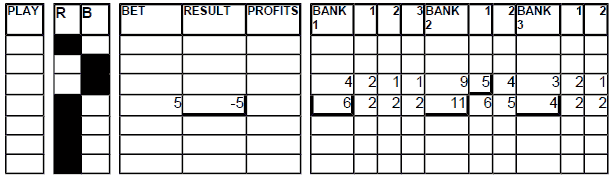
GRAPHIC 32
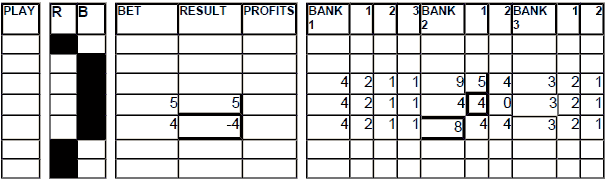
A very important detail, when the failed recovery bet is divided into 3, the first part is added to the corresponding bank, and the following two are added to the remaining banks from left to right. This rule has an only exception when the deficit surpasses 15 units. As a precaution against the persistence of the situation, we will add to this bank the smaller part and the remaining two will be put in the same way from left to right in the remaining banks.
GRAPHIC 33
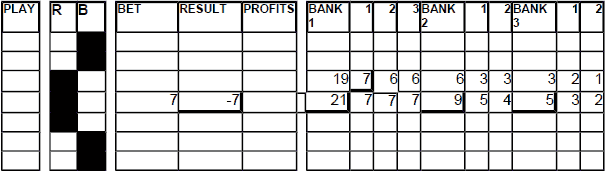
In the case of 2 banks exceeding 15 units, we will follow the priority from left to right and the remaining quantity will be put in the last. And in the totally unlikely fact that 3 banks exceeded 15 units, we will follow the initial procedure.
GRAPHIC 34
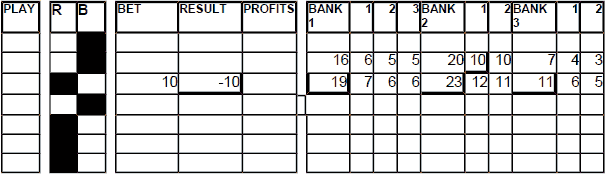
We have of taking advantage also the greater appearance of the one phenomenon and the closes to zero or important decrease of the deficit of the corresponding bank, to get lighter the deficit of the other 2 banks. We establish a maximum deficit and closing figure for every one of the banks:
|
|
DEFICIT |
CLOSING
|
|
BANK NUMBER 1 |
15 |
5 |
|
BANK NUMBER 2 |
10 |
4 |
|
BANK NUMBER 3 |
6 |
0 |
When one of the banks closes, if the other banks even or surpass the indicated figure, their deficit will be divided with the bank that there has closed. We will put 3 examples:
BANK NUMBER 1 remains with an inferior deficit of 5 units. The bank number 2 super 10 units. Bank number 2 divides its deficit with bank number 1.
|
|
DEFICIT BEFORE |
DEFICIT AFTER
|
|
BANK NUMBER 1 |
3 |
8 |
|
BANK NUMBER 2 |
13 |
8 |
|
BANK NUMBER 3 |
4 |
4 |
BANK NUMBER 2 remains with an inferior deficit of 4 units. The banks' numbers 1 and 3 divide their deficit with bank number 2.
|
|
DEFICIT BEFORE |
DEFICIT AFTER
|
|
BANK NUMBER 1 |
17 |
11 |
|
BANK NUMBER 2 |
3 |
10 |
|
BANK NUMBER 3 |
12 |
11 |
BANK NUMBER 3 closes to 0. Bank number 2 divides his déficit with bank number 3
|
|
DEFICIT BEFORE |
DEFICIT AFTER
|
|
BANK NUMBER 1 |
6 |
6 |
|
BANK NUMBER 2 |
17 |
9 |
|
BANK NUMBER 3 |
0 |
8 |
GRAPHIC 35
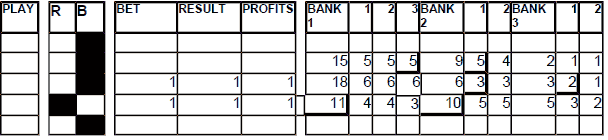
The balance between the different deficits is important so that the bets are not increased quickly when one of the phenomena delays his appearance. For so much, always exist the conditions of the values of LIMIT and CLOSE we can to do the operations explained previously.
We will play as there were 3 different players, but mutually helping them in critical situations. The first player attempts to obtain as net profits the chips produced by the series of 2, the second player makes the same with the series of three and the third player with the series of 4.
After an intermittence, in the second play, we will play a first recovery bet of bank number 1.
GRAPHIC 36

GRAPHIC 37
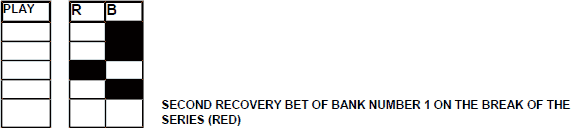
GRAPHIC 38
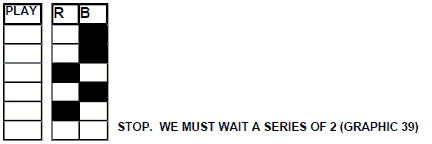
When we have a series of 2, in the third play we will make 2 bets, 1 chip on the break of the series, and only recovery bet of column number 3 of the bank 1, and at the same time a first recovery bet of bank number 2.
Try This Strategy in TOP Live Casinos





GRAPHIC 39
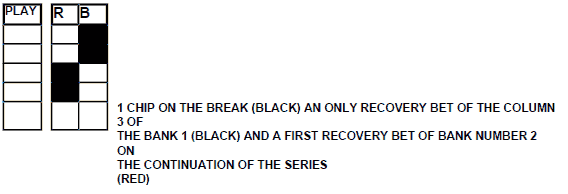
When a series of 3 appears, in the fourth play we will make 3 different bets, 1 chip on the intermittence, a second recovery bet of bank number 2, and the first recovery bet of bank number 3.
GRAPHIC 40
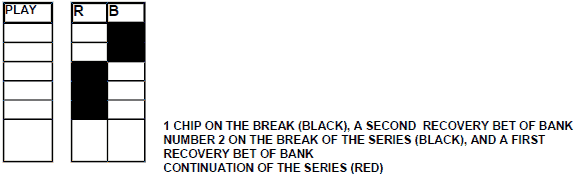
When a series of 4 appears, in the fifth play we will make 2 bets, 1 chip on the intermittence and the second recovery bet of bank number 3.
GRAPHIC 41
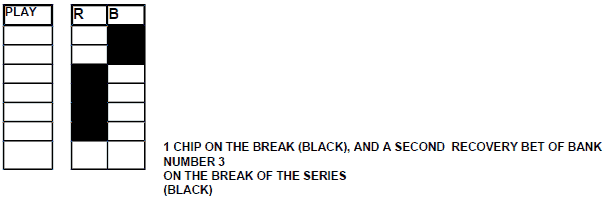
As we can see, in 3 plays we will make opposed bets but we have to see the procedure followed by each bank as an independent process that has an only purpose: to obtain, on the one hand, greater resistance against adverse situations and besides net profits consisting in the sum of all the units bet on the break of the series of 2, of 3 and 4.
GRAPHIC 42
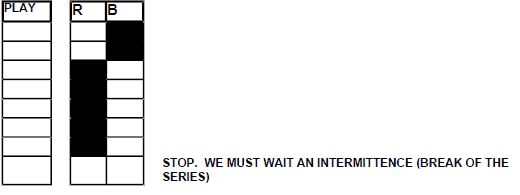
The real bet will be the result of adding or subtracting the different bets. It is easy to understand that, unlike the previous method, in this, we will normally have some recoveries still to be closed, but it is also possible to close them all with a given sequence (series in diminishing order: 4 - 3- 1 - 1 or other sequences that would leave us a minimal deficit in some of the banks). The most remarkable fact is the calmness that it gives us during the game and the great resistance that is obtained by having the deficit divided into 3 and being able to ease the bank that causes us more problems.
The only defect of the system is its relative complexity as we have to make so many operations in the same play, but this complexity reduces with practice. For all systems it is advisable to make many tests before playing with real money, in this, we emphasize the importance of assimilating well the mechanism so that you make all the operations automatically and you can perfectly control the game The last point: Appearance of the zero. Until the moment we thought it unnecessary to risk to recover the losses produced by its appearance, but after all the tests made and relying on the greater resistance that has the method, we will let it to the election of the player. The procedure to follow when it appeared would be to divide the losses into 3 and add them to the banks, but from right to left, because of the reason previously explained (ex: BET: 8. LOSS: 4. ORDER: 1, 1, 2).
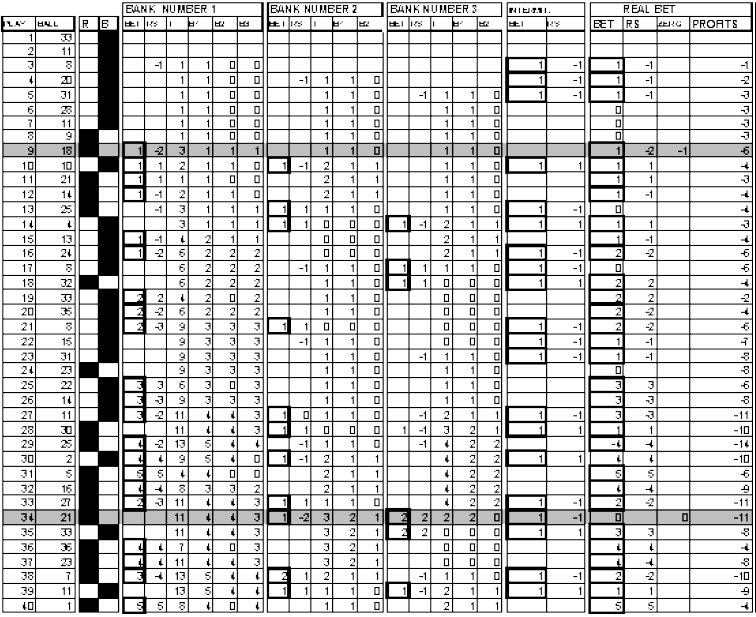
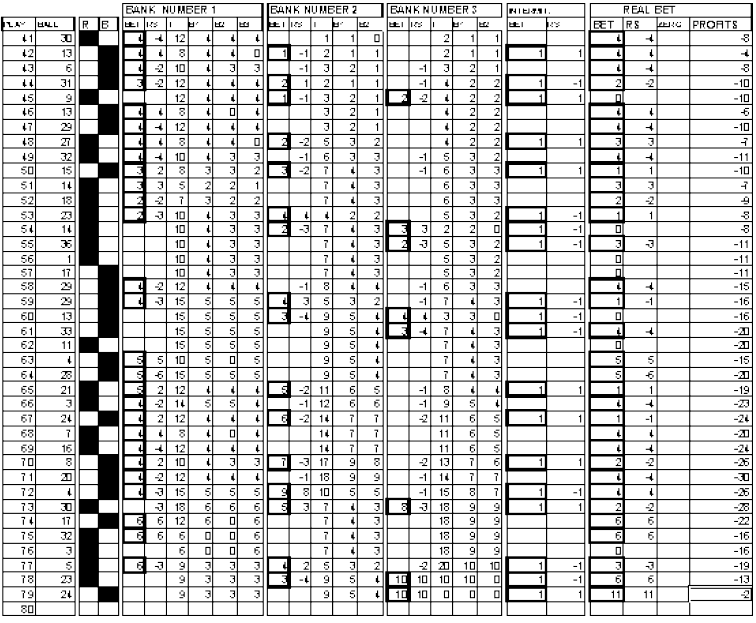
We will work on the sequence of the graphics 19 and 20, a very critical sequence so that the results can be compared and demonstrate the theory explained so far.
GRAPHIC 43
GRAPHIC 44
COMMENTARY ON THE SEQUENCE
PLAYS 3, 4, and 5: We bet a chip on the intermittence and the losses go to the respective banks. As there is no previous deficit, we make only one bet.
PLAYS 6, 7, and 8: No bet. We wait for the first intermittence, which happens in play number 8.
PLAY 9: We make the first recovery bet of bank number 1. It has previously appeared a zero. We repeat the bet, we added a unit to bank number 1, and we reflect the loss in the PROFITS column.
PLAY 10: We have a series of 2. First recovery of column 3 of bank number 1. We also make the first recovery bet of bank number 2 on a series of 3 and we bet a unit on the intermittence. In this case, the real bet is 1.
PLAYS 11 and 12: Recovery in bank number 1
PLAY 13: Pay attention that the chip lost when playing on the intermittence is added to bank number 1.
PLAY 14: We have a series of 3. We make a second recovery of bank number 2, the first recovery of bank number 3 and we bet a chip on the intermittence. The real bet is the result of adding the chips bet on the intermittence and the break of the series of 3 (bank number 2) minus the bet made on the continuation of the series (bank number 3).
PLAY 16: We affect the recovery bet of column 3 of bank number 1.
PLAY 17: We make the first recovery bet of bank number 3 and we bet a chip on the intermittence. This lost chip goes to bank number 2.
PLAY 18: We make the second recovery bet of bank number 3 and we bet a chip on the intermittence. The real bet is the sum of these two bets.
PLAY 20: We lose the second recovery bet of bank number 1.
PLAY 26: It has been lost the second recovery bet of bank number 1 and it is equal to 3 units. It is not distributed between 3 banks.
PLAY 29: It has been lost the first recovery bet of bank number 1 and it is equal to 4 units. It is distributed between 3 banks.
PLAY 45: Bank 3 is super the limit, bank 2 is under the value of close. The deficits are added and distributed. The same fact occurs in plays 51 and 53.
PLAY 55: We have made a second recovery bet and it has failed. But we have also lost the chip bet on the intermittence. Observe that the result is -3 and the deficit in this bank goes from 2 to 5 units.
PLAY 73: We have closed the recovery in bank number 2 and we have a deficit higher on 10 units (- 20) in bank number 3. We divide it with bank number 2 so that the two banks have a deficit of 10 units. Bank number 1 continues unalterable.
PLAY 78: We affect a first recovery in the bank number. 3 and is winner At the same time the chip bet to the intermittence and lost is added to the bank number 2.
PLAY 79: We affect the second recovery in bank number 3 and are the winner. None of the banks 1 and 2 super theirs limits and continue inalterable.
We end the sequence with a deficit of - 2 chips. We still have to recover 9 units of bank number 1 and 9 of bank number 2. It would make a total of 16 chips that are the 16 series of 2, 3, and 4 appeared.
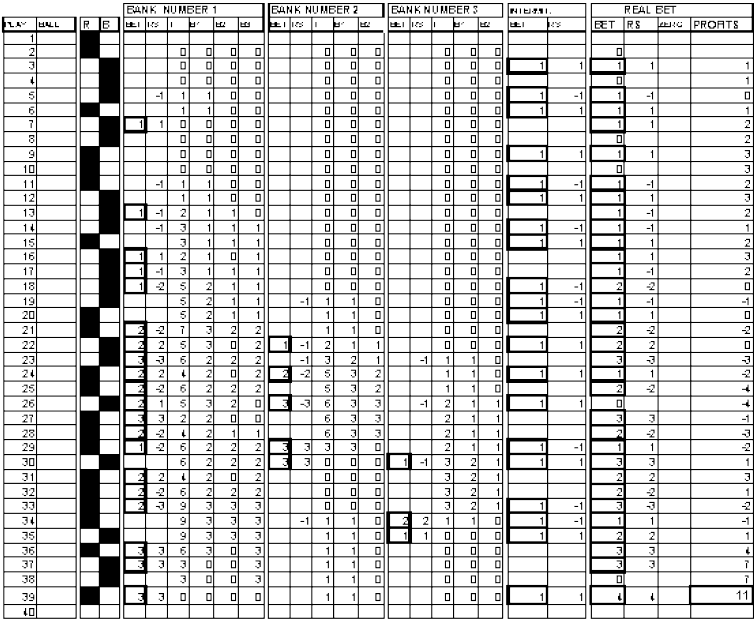
This is a very unfavorable sequence for the system (with a clear dominance of the large series on the shorts) and no matter what it ends with losses. What imports it is to know how resisting it when is presented, for to can win after with the "normal" sequences. Everybody knows to win in favorable situations, but well few know to make it in the unfavorable. At any rate, we will present a short sequence of 40 spins more current in the game table and we will see clearly which is the yield that can obtain the system with alternated gambling (graphic 45).
COMPARISON WITH GRAPHICS 19 And 20
|
|
GRAPHICS 19 And 20 |
GRAPHICS 43 And 44 |
|
MAXIMUM DEFICIT |
-172 |
-30 |
|
MAXIMUM BET |
93 |
11 |
|
MAX. QUANTITY RISKED |
265 units |
34 units |
GRAPHIC 46
GENERAL COMMENTS ON THE METHOD
- In alternation situations of all the series, it will go on closing the different recoveries and obtaining profits.
- In critical situations, it avoids the collapse by preventing the rapid increase of problematic deficits by dividing the highest bets into the three banks and making that always one of them closes the recovery.
- The maximum risked quantity has been 34 units. Normally we would begin the game with 50 units, therefore, we would be yet far from the limit.
- This sequence can appear but rarely. Normally, the game is very changing (with alternation of all kinds of series) which has always made it very difficult to apply an effective method for all kinds of situations. And one must recall that at the end of 250 plays, the distribution of the series will have come closer to the one which we know as ideal.
- Logically, after this sequence, there will come another difference that will take us back to void deficits or non-existent and the profits will be put on the same level with the total of similar series of 2, 3, and 4.
- We achieve a great resistance to overcome the most adverse situations.
- The necessary initial capital is low. With 50 chips we cover sufficiently any critical situation.
- The method gives great confidence because we know that sooner or later we will lose some of the banks and if there is some indeed problematic one, we will be able to ease it.
- Our position is much more comfortable. Unlike before we do not have to rely on the appearance of an only phenomenon to close the recovery. When this did not happen or took much time it appears, we could ourselves be compelled to abandon the game having lost all the initial capital. Now we have 3 different options and each one collaborates with the others.
- The losses caused by zero can be recovered. A possible option is to wait until they add up to 3 units and to distribute them into 3 banks. There are other options, but we leave them to the player’s imagination. The only thing will be to add a column next to zero, in which we control the total of these losses.
PLAYS IN THOSE WHICH THE REAL BET IS ZERO
ONLINE CASINO: We must of betting. We will play always a unit to the break of the series. The chips wined go directly to profits. The lost chips will be put on bank 1 or 2 (the one which has a smaller deficit), never in bank 3.
Depending on the class of game, at the end of the session of 250 spins, it can suppose some profits of 40 chips more, but the risk is greater.
REAL ACTION: I advise not to bet since the possibilities of success of the system will be greater.
In any case, the player can choose between not to bet (and take advantage to be relaxed) or following the previous procedure.
THE THREE KEY FACTORS OF THE SUCCESS OF THE METHOD
- RECOVERY OF LOSSES BETWEEN 3 INDEPENDENT BANKS
- DIVISION OF THE LOSSES SUPERIOR TO 3 UNITS BETWEEN 3 BANKS.
- A DECREASE IN THE DEFICITS IS MORE PROBLEMATIC WHEN A BANK CLOSES TO ZERO OR REMAINS WITH A DEFICIT VERY LOW.
YIELD OF THE SYSTEM IN 250 PLAYS.
- Not recovering the losses caused by the zero: 50 - 60 chips.
- Recovering the losses caused by the zero: 55 - 65 chips.
AVERAGE YIELD OF THE SYSTEM: Between 0.20 and 0.30 chips per play.
In this method, we can speak of a team game but with only one player. The only defect it has (the advantages we have already seen) is the great concentration that demands on the player at all times, and the fact of having to make until four different operations.
Is there any form of simplifying the system? Yes, and we present it below:
The situation is complicated much when the deficits of the banks are very high. Then it is very difficult to control the nerves (we are losing) and to accomplish all the necessary operations in each spin. There is a way yet simpler and more intelligent of play, to divide the session in games shorter using the following parameters:
- PROFITS TO OBTAIN: +5 +10
- INITIAL CAPITAL: 5 +10
We will stop the game and we will return to begin it with the banks to ZERO when:
- Profits + following bet >= PROFITS TO OBTAIN (The profits obtained until the moment, plus the bet that we would have of effecting to the following play surpass 5 or 10 units).
- Risky capital + following bet >= INITIAL CAPITAL (The losses plus the bet that we would affect in the following play surpass 5 or 10 units).
These conditions will be performed every 20 - 60 spins. In a session of 250, we will play an average of 4 - 8 games. The final balance will be favorable, at all times we will control the possible losses and we will be able to stop the game when we want.
TOTAL CAPITAL: 25 - 50 chips (necessary to confront the total of 250 spins).
Playing in this way we obtained:
- To avoid the nerves since NEVER we will have of confronting large recoveries.
- The operations between banks will be minimal and will be able to do them with much easiness.
- The bets will be ALWAYS small.
- When we add the loss produced by the zero to the deficits it will not alter them too.
- We will abandon the game if the total Profits arrive in a given figure (example: +20 - +40).
Test the program (two options) with these parameters and you will see how always at the end of 250 spins the balance is favorable.
Playing in this way the game is simplified much. In any case, we believe that is worth the trouble to make many tests until perfectly assimilating the mechanism, obtaining the necessary agility. live roulette players know that a method that guarantees such a high percentage of success in ALL situations could not have a relatively easy application. If someone believes that its application is too complex, he always has simpler options previously explained in these pages, but they will not guarantee the same results. We limit ourselves to explain how to play in the most intelligent possible way and we wanted to demonstrate that the set phrase heard so many times since this game was invented – THE BANK ALWAYS WINS - is not true.
Dont forget: This strategy collected from internet. LiveCasinoGuru is not responsible for the accuracy of this information. It is presented for information purposes only. Our task is to collect and present strategies to share experiences. Any possible wins and losses are the responsibility of the player.